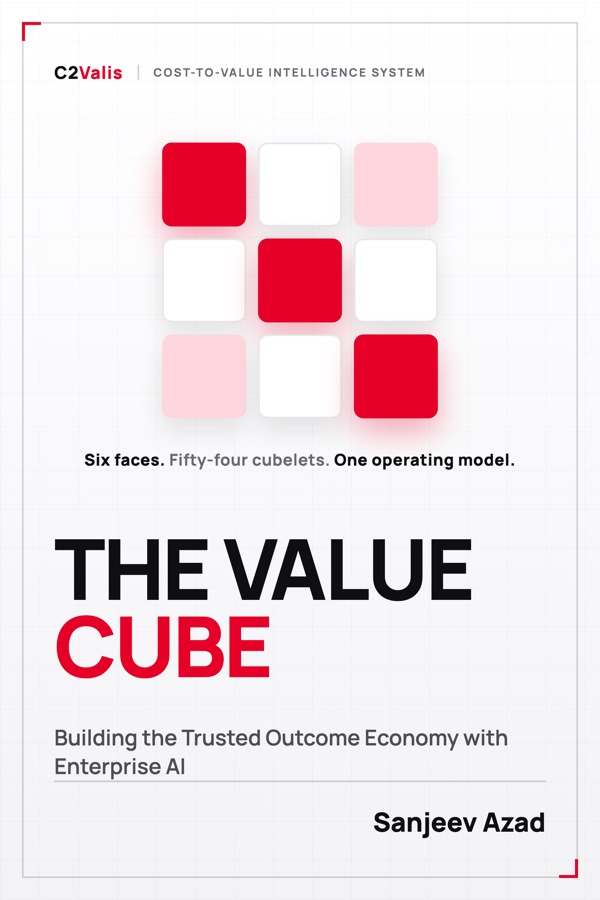
The Value Cube
Building the Trusted Outcome Economy with Enterprise AI
- 400 pages · 6×9
- 7 parts · 30 chapters
- Paperback & hardcover
- ISBN 9798906061492
Same book, different storefronts. Pick the one for your region
Notion PressPaperback & hardcover
- Amazon.inIndia store
- Amazon.comUS store
- Amazon.co.ukUK store
About the book
Enterprises can measure what GenAI costs to the cent, and still can't say what it's worth. Cost is instantly visible; value stays murky. So teams optimise the only number they can see, cutting tokens while quality, trust, and rework quietly erode.
C2Valis reframes the problem around the trusted outcome: the accepted, citable, useful result. Six faces, 54 cubelets, a guardrail-capped Cube Score, a maturity path, fifteen optimisation patterns, and an evidence discipline that forbids a claim until it is proven.
A practical, evidence-first operating manual, written in two tracks: executives can read the framing, practitioners get the depth.
Try the framework first
The model in the book is backed by three open tools. Free, no signup, and nothing you enter leaves your browser. They are the fastest way to judge whether the thinking holds up before buying anything.
- The Value Cube ↗All six faces and 54 cubelets, explorable in 3D
- Face trade-offs ↗What optimising one face does to the other five
- Cube Score ↗Score your own system and find the face to fix first
The operating model itself is written up as C2Valis, and I talk about it at conferences and roundtables.
Watch The AI Value System, a short narrated video on why machine capability is not enterprise value.
The second book
Notion Press · 2026
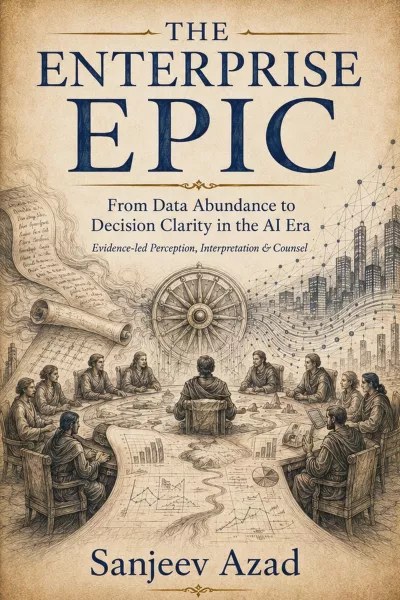
The Enterprise EPIC
From Data Abundance to Decision Clarity in the AI Era
Project EPIC, short for Evidence-led Perception, Interpretation and Counsel: eleven capabilities, each borrowing a figure from the Mahabharata, for turning abundant data into decisions that hold up.
In progress
Scroll for more →
Three more books are in development. Each one takes on a different part of the same problem: getting provable value from AI once the technology is no longer the hard part.
Domain Before Agents
The CXO Blueprint for Agentic AI in Financial Services
FinTech leaders don't need another model-first AI strategy. They need a domain-first blueprint for turning financial processes into agent-ready systems without losing trust. Three instruments carry it: D-FACE for whether a use case is ready to scale, the Autonomy Ladder for how much authority software should hold, and the Agentic Control Envelope for the minimum controls around a material action.
Human Transformation AI
The Evidence-Driven Discipline of Changing How People Work in the Age of AI
AI transformation isn't complete when a model is deployed. It is complete when people change how they think, decide, and produce value, and when that change outlasts the launch campaign. Every intervention is treated as a hypothesis, graded against five evidence labels from Established to Unsupported, and kept only for as long as the evidence holds.
The Economics of Digital Waste
The Hidden Cost of Infinite Software
Once code became cheap enough to generate on demand, the constraint that used to stop teams building the wrong thing quietly disappeared. This is an accounting of what replaced it: overproduction, duplicate intent, token and reasoning waste, orphaned software nobody owns, and the several kinds of debt that follow well beyond the technical one.